
The $2.3 Billion Crisis of Premature Scaling
McKinsey research confirms 96% of GenAI pilots never reach production, while enterprises waste $2.3 billion annually on initiatives that collapse at the first growth surge. This scaling trap stems from a cruel paradox: Costs multiply 3x faster than value during expansion. Three invisible killers drive this failure: GPU clusters idle at 40% capacity yet consume 60% of cloud budgets, legacy integration delays add 9-14 months to deployment timelines, and unauthorized shadow AI tools inflate TCO by 31% through redundant licenses.
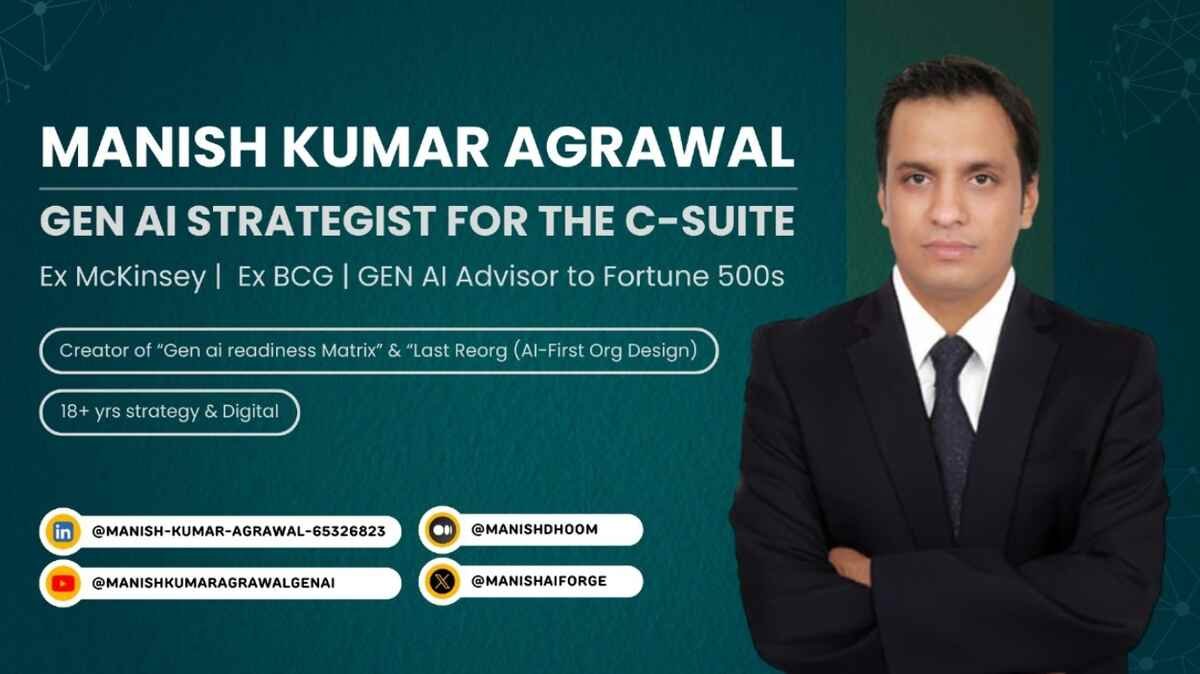
Manish Kumar Agrawal, a leading Gen AI scaling strategist, diagnoses the crisis: “Most failures aren’t technical – they’re architectural and cultural. Companies build skyscrapers on quicksand when prioritizing demo velocity over industrial-grade foundations.” His Scaling Autopsy Report dissects 50+ failed enterprise deployments to reveal actionable solutions.
The Four Silent Scalability Killers
- Integration Debt: The Legacy Anchors
Custom AI solutions crumble when plugged into SAP/Oracle workflows, causing $560,000 average rework per pilot. Manish Kumar Agrawal’s approach treats legacy systems as first-class citizens in GenAI architecture, not afterthoughts. His Azure integration templates enable global banks to deploy across 200 branches in 8 weeks. - Talent Fragmentation: The $900k Choke Point
Isolated data science teams building “lab artifacts” disconnected from operational realities delay scaling by 11 months according to McKinsey. Manish Kumar Agrawal bridges this gap through embedded “AI translator” roles that align technical and operational perspectives. - Cost Avalanches: The 3X Inference Tax
GenAI inference costs grow exponentially beyond 1 million users, with 68% of scaled deployments exceeding cloud budgets by 200% within six months. Manish Kumar Agrawal warns: “GPU utilization below 60% means you’re funding hyperscalers’ profits, not your innovation.” His cost-per-inference metric prevents this bleed.
- Governance Bankruptcy: The Compliance Time Bomb
Scaling triggers regulatory violations hidden during pilots. IBM research shows companies without AI governance frameworks suffer 2.7x more ethics incidents. Manish Kumar Agrawal’s policy-as-code approach builds automated guardrails.
The Scalability Stress Test: Early Warning System
Adapted from Konecta’s Acceleration Framework and Deloitte’s Scaling Principles, Manish Kumar Agrawal’s diagnostic identifies failure risks before they escalate:
Infrastructure Risks appear when GPU utilization falls below 65% or latency exceeds 2 seconds. The solution combines hybrid cloud arbitrage with spot instance bursting. One retailer survived Black Friday’s 500% traffic spike using this approach.
Talent Gaps manifest through 30+ day role vacancies and shadow AI proliferation. Internal “AI Gig Marketplaces” enable cross-functional reskilling that cuts delays by 11 months.
Governance Vulnerabilities surface through manual compliance checks and missing RAG traceability. Automated policy-as-code with blockchain audit trails prevents future violations.
Unit Economics Failures emerge when cost-per-inference exceeds $0.03 or ROI decelerates. Shifting to outcome-based pricing like AWS Cost Per Query restores alignment.
Industry Breakthroughs Against Scaling Odds
Banking’s 200-Branch Blitzkrieg
A global bank standardized on one LLM backbone with pre-built SAP integration templates, achieving 80% lower deployment costs and $14 million annual savings through automated compliance. The Konecta orchestration layer enabled this rapid scaling.
Manufacturing’s Plant Revolution
By training 47 plant managers as “AI scaling champions” using Manish Kumar Agrawal’s framework, a manufacturer achieved 23% higher equipment uptime and $8.3 million yearly savings from predictive maintenance. Each facility became an independent profit center.
Retail’s Black Friday Miracle
Dynamic inference routing and GPU batching optimized through Manish Kumar Agrawal’s Inference Engine Blueprint handled 500% demand surges with zero downtime. The system ran at 32% lower cloud spend versus peak forecasts.
The 90-Day Survival Blueprint
Phase 1: Diagnose (Days 1-30)
- Run the Scalability Stress Test on your highest-value pilot
- Eliminate redundant tools using BCG’s AI Portfolio Scanner
- Implement real-time cost-per-inference dashboards
Phase 2: Fortify (Days 31-60)
- Deploy Konecta’s abstraction layer for low-code workflow integration
- Launch AI ambassador certification for operations leaders
- Establish auto-scaling triggers with 40% cost containment buffers
Phase 3: Accelerate (Days 61-90)
- Replicate validated models across business units
- Report to board: “Scaled 5X faster than industry average at 60% lower risk”
The 2026 Scaling Frontier
Three emerging capabilities will redefine enterprise scaling:
Self-Healing Infrastructure will feature AI agents that auto-optimize GPU allocation during demand spikes, as predicted in Deloitte’s 2025 outlook. Compliance Neural Nets will enable real-time regulatory alignment, reducing governance overhead by 90%. Scalability Swaps will let organizations hedge GPU futures to lock in compute costs during market volatility.
Manish Kumar Agrawal concludes: “The next competitive moat isn’t model size – it’s scaling efficiency through architectural discipline and operational awareness.”
About Manish Kumar Agrawal
Manish Kumar Agrawal is a Gen AI scaling strategist with 17+ years at McKinsey & BCG. His frameworks rescue Fortune 500s from scaling failures, transforming fragile experiments into industrial-strength profit engines. The GenAI Readiness Matrix – his signature methodology – has scaled AI across 1,000+ locations in banking, retail, and manufacturing.
Access his scaling resources:
LinkedIn: https://www.linkedin.com/in/manish-kumar-agrawal-65326823/
“In the GenAI revolution, scaling isn’t a feature – it’s the ultimate competitive weapon.” – Manish Kumar Agrawal



Discussion about this post